It is with great pleasure that Dot and I announce the arrival of our second grand-child, Ella Castle, born on 30 May at 8.25 pm Santa Clara (California) time or 31 May at 1.25pm Eastern Standard Time (Australia) or 4.25am UK Summer Time.
I have just talked with Emily and Greg by phone and the baby is doing fine. She was 4lb 9 oz (or 2.055 kg) at birth, 18" long (45.7 cm) and, in Emily's word, beautiful. I believe that she was delivered by Cesarean Section, but that is still to be confirmed. Emily was tired and a little sedated, of course, but still lucid and very happy. Ella required no specialist medical treatment and was sleeping alongside.
More details, including pictures, will come soon. So, we were spared a fourth June birthday celebration! I, Max and Dot's brother, Dick, are the others.
AS
Tuesday, 31 May 2011


Sunday, 15 May 2011
Cosmic Coincidence
At a little after 5am this morning I was outside in -7C temperatures watching Jupiter, Venus and Mercury rise just above the eastern horizon. Twelve hours later, at a little after 5 pm I was in UNE's Madgwick Hall listening to the thunderous end of another celestial work - in more ways than one - and the outside temperature had reached 15C. That's a 22C daily range! What caused the thunder inside? Well, it was the conclusion of Haydn's brilliant oratorio, the Creation, an event that preceded this morning's planetary extravaganza by about 13 billion years.
The Armidale Symphony Orchestra has rarely, if ever, exceeded the quality of this afternoon's concert, performing just the one two hour long work. They fielded amonst 50 musicians, many of whom I've known personally for decades, playing the complete suite of instruments directed by the score, including a harpsichord which had a key continuo role. And the quality of their ensemble and bit-part playing matched Haydn's great score, with its many subtleties such as attempts to portray the entropic chaos before the big bang and the mysteries of the early universe.

The Creation also makes large choral demands and Armidale was up to that task as well, fielding a choir of almost 80 persons, many of whom I also know ... including one of my doctors. Alas, two of the three soloists were imported for the occasion, with only Bethany Shepherd, the soprano, having local connections. The choir and soloists also discharged their roles very creditably under the tutelage of Wendy Huddlestone, the wife or Dot's former, but long retired, boss! Wendy might have retired from her music teaching career at Armidale High School 11 years ago, but she kept the ensemble of nearly 130 musicians under tight control and kept a cracking pace. Indeed she made the choral climaxes truly exciting and vibrant, far from the often flagging tempi of amateur orchestras. No wonder, then, that the applause at the end went on for a long time. The audience of maybe 250 people was thrilled by the classy performance.


For the record, Haydn's Creation was inspired by listening to Handel's oratorios, including the Messiah, in Westminster Abbey, and by his meeting with the Astronomer Royal, Herschel, who had recently discovered Uranus. The first public performance was in 1799 and it became an instant hit, but I doubt if it were much more polished than today's Armidale performance. If you ever get the chance, which may be unlikely given the rarity of performance, please try to attend. You'll be charmed and entertained. How can a town of 25,000 people can keep on performing major and demanding works in the classical repertoire - another was Mahler's Resurrection Symphony - based largely on its own home-grown and high quality talents. I'll let you, dear reader, figure that one out!
The Armidale Symphony Orchestra has rarely, if ever, exceeded the quality of this afternoon's concert, performing just the one two hour long work. They fielded amonst 50 musicians, many of whom I've known personally for decades, playing the complete suite of instruments directed by the score, including a harpsichord which had a key continuo role. And the quality of their ensemble and bit-part playing matched Haydn's great score, with its many subtleties such as attempts to portray the entropic chaos before the big bang and the mysteries of the early universe.

The Creation also makes large choral demands and Armidale was up to that task as well, fielding a choir of almost 80 persons, many of whom I also know ... including one of my doctors. Alas, two of the three soloists were imported for the occasion, with only Bethany Shepherd, the soprano, having local connections. The choir and soloists also discharged their roles very creditably under the tutelage of Wendy Huddlestone, the wife or Dot's former, but long retired, boss! Wendy might have retired from her music teaching career at Armidale High School 11 years ago, but she kept the ensemble of nearly 130 musicians under tight control and kept a cracking pace. Indeed she made the choral climaxes truly exciting and vibrant, far from the often flagging tempi of amateur orchestras. No wonder, then, that the applause at the end went on for a long time. The audience of maybe 250 people was thrilled by the classy performance.


For the record, Haydn's Creation was inspired by listening to Handel's oratorios, including the Messiah, in Westminster Abbey, and by his meeting with the Astronomer Royal, Herschel, who had recently discovered Uranus. The first public performance was in 1799 and it became an instant hit, but I doubt if it were much more polished than today's Armidale performance. If you ever get the chance, which may be unlikely given the rarity of performance, please try to attend. You'll be charmed and entertained. How can a town of 25,000 people can keep on performing major and demanding works in the classical repertoire - another was Mahler's Resurrection Symphony - based largely on its own home-grown and high quality talents. I'll let you, dear reader, figure that one out!
Saturday, 14 May 2011
Planetary Alignment
I have had a frustrating couple of days because one of the great celestial displays has been denied me, despite my best intentions. For the first time in over a century, four planets in the solar system - Jupiter, Venus, Mercury and Mars - have collected in Y-shaped fashion in one small corner of the sky. The southern display over the east coast of Australia has been especially good because it's late Autumn and the nights are long. Since the display occurs just before dawn, the extra period of dark is a great help. So, too, is the generally crystal clear atmosphere.
Well, that's the theory, but Armidale's weather has deteriorated markedly over the last couple of days. We've had the first blast of winter and, although the days are still quite good at 13C, there is a lot of misty cloud hanging around, especially at around dawn. I'm typing this at nearly 7.30 am and the cloud is slowly clearing to a blue sky - but much too late for planet-gazing and I'm in danger of missing my chance. This is a pity, because the next such display is apparently scheduled for 2056 and my chances of seeing it are slim. I'd be about 111 at he time.
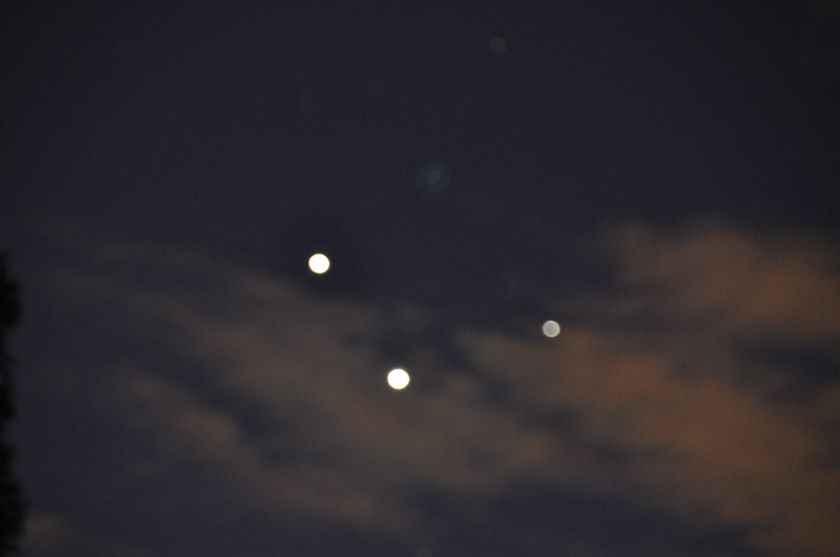
So, I attach a couple of images of what I would have seen with a clear sky. The images were posted on the web by Sydney residents. The first shows Jupiter, Venus and Mercury (the small blob) in V formation. The second adds Mars a fair way below. You can see the glow of dawn in the second and can appreciate the limited opportunity to see the display just as it rotates above the horizon. Both yesterday and today I arose shortly after 5am. Yesterday, I jumped in the car and drove around trying unsuccessfully to find a suitable hole on the clouds Today, I went outdoors and surveyed the cloudy skies before giving the game away.


Postscript: 15 May 2011: The sky cleared tonight and I leapt out of bed at 5am to scan the horizon for this celestial display. It was a beautiful sight and crystal clear - very much like the second of the pictures.
AS
Well, that's the theory, but Armidale's weather has deteriorated markedly over the last couple of days. We've had the first blast of winter and, although the days are still quite good at 13C, there is a lot of misty cloud hanging around, especially at around dawn. I'm typing this at nearly 7.30 am and the cloud is slowly clearing to a blue sky - but much too late for planet-gazing and I'm in danger of missing my chance. This is a pity, because the next such display is apparently scheduled for 2056 and my chances of seeing it are slim. I'd be about 111 at he time.
So, I attach a couple of images of what I would have seen with a clear sky. The images were posted on the web by Sydney residents. The first shows Jupiter, Venus and Mercury (the small blob) in V formation. The second adds Mars a fair way below. You can see the glow of dawn in the second and can appreciate the limited opportunity to see the display just as it rotates above the horizon. Both yesterday and today I arose shortly after 5am. Yesterday, I jumped in the car and drove around trying unsuccessfully to find a suitable hole on the clouds Today, I went outdoors and surveyed the cloudy skies before giving the game away.

Postscript: 15 May 2011: The sky cleared tonight and I leapt out of bed at 5am to scan the horizon for this celestial display. It was a beautiful sight and crystal clear - very much like the second of the pictures.
AS
Sunday, 8 May 2011
Mothers Day 2011
Today is Mothers Day, at least in Australia. Dot received a large van Gogh-like bouquet of flowers from Em and Beck. I use that description purposefully because the tulips were in the artist's favourite colour, yellow and the rest of the bunch were Irises, just as in one of his most famous paintings completed while he was living at the asylum at Saint Paul-de-Mausole in Saint-Rémy-de-Provence in the last year before his death in 1890. That painting is now supposedly at the J. Paul Getty Museum in Los Angeles, but you could be mistaken for thinking that it's in our dining area!

While we've been talking about illusions, I'll pop a question. I presume most of my readers have visited some of the world's famous art galleries like, for example, the Louvre, the Musée d'Orsay, the Pompidou Centre, the Tate Gallery (and the Tate Modern), the Rijksmuseum, the Uffizi, the Metropolitan Museum in New York, or the Hermitage in St Petersburg. I've visited them all. Well, the New England region stages a great art display once year, though perhaps not quite in the same league. Have any of you heard of the Currabubula Art Exhibition, now in its 48th year, which donates receipts to the Red Cross? Well we headed off there today, a round trip of about 280km from Armidale ... about 90 minutes away. Currabubula is hardly a global metropolis! In fact it's a tiny place. The whole district - including farming population - had only 389 residents in 2006. I doubt if the village is home to more than 200 people! The picture shows the main street of the CBD - actually it's just about the only street of any importance.

The exhibition is shown in the small village hall, not ideal conditions. And the artists are probably not household names like Leonardo, Rembrandt, Monet or Picasso, although their works were produced all over eastern Australia. Less convenient still, the organisers managed to hang no less than 667 work on the hall's walls and on temporary display boards placed in the middle of the narrow building. Needless to say, the pictures were crammed in as my own exhibits show below! When we got there in late morning, there must have been upwards of 150 people in the hall - it's a very popular event. So it was difficult to stand (or sit) in any comfort in what resembled a densely packed scrum. Most galleries have abundant space for their displays and some, like the Rijksmuseum's display of Rembrandt's Nightwatch, have rooms housing just one work with tiered seating to view critical works in relaxed comfort.


Most of the works were technically competent, and some showed considerable creativity in design or use of colour. However, the most prominent genres were Australian rural landscapes, animals (horses, sheep and poultry), and Parisian or Venetian street scenes - the former painted on rainy nights! No great blobs of colour here, or deformed women, or anything quasi-scientific like the decaying cat I once saw on video at the Tate Modern. Oh well, it was fun seeing an event we'd long heard about but never visited.
AS

While we've been talking about illusions, I'll pop a question. I presume most of my readers have visited some of the world's famous art galleries like, for example, the Louvre, the Musée d'Orsay, the Pompidou Centre, the Tate Gallery (and the Tate Modern), the Rijksmuseum, the Uffizi, the Metropolitan Museum in New York, or the Hermitage in St Petersburg. I've visited them all. Well, the New England region stages a great art display once year, though perhaps not quite in the same league. Have any of you heard of the Currabubula Art Exhibition, now in its 48th year, which donates receipts to the Red Cross? Well we headed off there today, a round trip of about 280km from Armidale ... about 90 minutes away. Currabubula is hardly a global metropolis! In fact it's a tiny place. The whole district - including farming population - had only 389 residents in 2006. I doubt if the village is home to more than 200 people! The picture shows the main street of the CBD - actually it's just about the only street of any importance.


Most of the works were technically competent, and some showed considerable creativity in design or use of colour. However, the most prominent genres were Australian rural landscapes, animals (horses, sheep and poultry), and Parisian or Venetian street scenes - the former painted on rainy nights! No great blobs of colour here, or deformed women, or anything quasi-scientific like the decaying cat I once saw on video at the Tate Modern. Oh well, it was fun seeing an event we'd long heard about but never visited.
AS
Friday, 29 April 2011
A Transcendental Experience III
This posting might best be labelled 'Down to Earth'. All good things come to end and, alas, we had to touch ground at some point. However, our accomplished pilot conceded that our trip had been a little longer than usual because of the favourable conditions. The landing was perfect and unlike the balloon preceding us the basket remained upright. We descended slowly over a line of trees and the odd fence to rest gracefully in a paddock attached to a CSIRO experimental farm. On reaching the ground, the balloon rapidly deflated and when most of the air had, so to speak, been exhaled we exited the basket with various degrees of agility. Nothing remained but for us to pack away the gear once the support team had reached us in their 4WD vehicles and trailers. The latter task was difficult as our paddock had no observable gate and no paths crossing it.
After about 15 minutes the cavalry arrived and we began the task of winching the basket on to the trailer (which was quick and easy), and packing up the balloon, which was time- and labour- consuming. The balloon had to be folded carefully so that formed a compact mass for stuffing into a bag, and there was a lot of material involved! Actually the most difficult bit was packing the balloon into its home - a rather large bag. Max came in useful at several stages, but especially when using his wine pressing skills bouncing up and down on the balloon to compact it into the bag. The pictures below follow this chain of events.


Those tasks complete, the convoy headed back to Rydges Hotel for a celebratory drink of champagne, a tradition apparently going back to the early days of ballooning in 1783 when the Montgolfier brothers first went aloft in a hot air balloon. That was followed in turn by a slap up breakfast at the hotel to finish off a memorable start to a day. All of this was complete by shortly after 10am, just 5 hours after we arose from our beds.
Thanks to Dawn Drifters for their professionalism, care and efficiency. The trip went without a hitch ... unless one counts the difficulties experienced in finding a way into our landing paddock!
AS
After about 15 minutes the cavalry arrived and we began the task of winching the basket on to the trailer (which was quick and easy), and packing up the balloon, which was time- and labour- consuming. The balloon had to be folded carefully so that formed a compact mass for stuffing into a bag, and there was a lot of material involved! Actually the most difficult bit was packing the balloon into its home - a rather large bag. Max came in useful at several stages, but especially when using his wine pressing skills bouncing up and down on the balloon to compact it into the bag. The pictures below follow this chain of events.


Those tasks complete, the convoy headed back to Rydges Hotel for a celebratory drink of champagne, a tradition apparently going back to the early days of ballooning in 1783 when the Montgolfier brothers first went aloft in a hot air balloon. That was followed in turn by a slap up breakfast at the hotel to finish off a memorable start to a day. All of this was complete by shortly after 10am, just 5 hours after we arose from our beds.
Thanks to Dawn Drifters for their professionalism, care and efficiency. The trip went without a hitch ... unless one counts the difficulties experienced in finding a way into our landing paddock!
AS
A Transcendental Experience II
Once aloft, we had the surreal experience of gliding silently in space a few hundred meters above familiar Canberra landmarks. This posting shows little more than a selection of the images we saw during our trip to give readers an impression of Canberra from the air. Remember that the trip took place early on an incandescent morning with brilliant visibility. The shadows, where observable, are long, but equally the pictures sometimes reveal large distance. The images are in time sequence, but taken with two different cameras.
So, on with the display. I will briefly describe each image below it.

The Carillon (bell tower) alongside Lake Burley Griffin with Civic (Canberra's commercial heart in the background.

Part of the Parliamentary triangle, with the High Court in the front left, Questacon (a science exhibition) in the white building (front right), the brownish Treasury Building (where Beck works and Max went to pre-school (above and slightly right), old Parliament House in the middle distance, and Capitol Hill with New Parliament House behind it. Note the Brindabella range in the distance rising to almost 2000m and the shadow of the balloon in the foreground.

In the middle ground are (i) the National Library, (ii) the Commonwealth Avenue Bridge, and (iii) the National Museum of Australia behind that. Note the considerable expanse of Lake Burley Griffin as it winds past Yarralumla, Government House.

ANZAC Parade leads to the War Memorial in the middle distance. Immediately behind us, on the other side of the lake, the ceremonial avenue stretches out to Parliament House.

Commonwealth Avenue leads from Civic - behind us - to Parliament House.

This view stretches over the National Museum towards the office towers of the Woden Town Centre. Woden is one of the major suburban clusters, along with Belconnen, Tuggeranong, and Gunghalin.

It is now Autumn and the many deciduous trees in Canberra are turning vibrant reds and yellows. This region north of Civic shows the beautiful display put on as the season changes towards winter.

Black Mountain and its communications tower are visible from most parts of the city.

The Canberra Stadium, in the suburb of Belconnen, is the premier sporting venue and I have seen matches there

Belconnen town centre is in the middle distance alongside Lake Ginninderra - one of Max's favourite play areas. And Belconnen is home to various strands of our family.
I hope you enjoyed these images as much as we did seeing the whole landscape evolve beneath us. The experience was magical.
AS
So, on with the display. I will briefly describe each image below it.

The Carillon (bell tower) alongside Lake Burley Griffin with Civic (Canberra's commercial heart in the background.

Part of the Parliamentary triangle, with the High Court in the front left, Questacon (a science exhibition) in the white building (front right), the brownish Treasury Building (where Beck works and Max went to pre-school (above and slightly right), old Parliament House in the middle distance, and Capitol Hill with New Parliament House behind it. Note the Brindabella range in the distance rising to almost 2000m and the shadow of the balloon in the foreground.

In the middle ground are (i) the National Library, (ii) the Commonwealth Avenue Bridge, and (iii) the National Museum of Australia behind that. Note the considerable expanse of Lake Burley Griffin as it winds past Yarralumla, Government House.

ANZAC Parade leads to the War Memorial in the middle distance. Immediately behind us, on the other side of the lake, the ceremonial avenue stretches out to Parliament House.

Commonwealth Avenue leads from Civic - behind us - to Parliament House.

This view stretches over the National Museum towards the office towers of the Woden Town Centre. Woden is one of the major suburban clusters, along with Belconnen, Tuggeranong, and Gunghalin.

It is now Autumn and the many deciduous trees in Canberra are turning vibrant reds and yellows. This region north of Civic shows the beautiful display put on as the season changes towards winter.

Black Mountain and its communications tower are visible from most parts of the city.

The Canberra Stadium, in the suburb of Belconnen, is the premier sporting venue and I have seen matches there

Belconnen town centre is in the middle distance alongside Lake Ginninderra - one of Max's favourite play areas. And Belconnen is home to various strands of our family.
I hope you enjoyed these images as much as we did seeing the whole landscape evolve beneath us. The experience was magical.
AS
A Transcendental Experience I
This is the first of three successive posts on what must be one of the world's most transcendental experiences - one I'd recommend to all my readers wherever you are. By good luck, Dot and I received a voucher for a hot air balloon excursion as a Christmas present last December. Thanks, guys, for the opportunity. We had a year to cash it in and, after an abortive try to get airborne last Wednesday, which failed on account of excessively strong winds and a lot of cloud cover, Thursday dawned clear and fine with a light breeze. Beck and Max also came along for the ride of a life-time.
So, we gathered together with our fellow balloonists at Rydges Hotel near Parliament House at 6am, a really early start for all of us. Then the Dawndrifters crew had to work out whether it was safe to lift off and where to start (and land) given prevailing wind conditions. That decided, we jumped into either of the two troop carriers provided, one towing the basket and the other the balloon, and headed off to the eastern end of Lake Burley Griffin. Getting the craft ready for ascent is part of the fun, and involved most of the passengers as well as the crew.
When arrived at our launch-pad, we found it occupied by two other balloons,one just about to lift off and other in mid preparation. We were therefore able to see their preparations as well as our own, which added to the excitement.

The first task was to unload the basket (pictured) and turn it on its side, and to unpack the balloon and stretch it out full length on the ground in front of the basket. You may recognise three of the participants in the front of the picture below.

By the way, it wasn't exactly warm at 6.30 on a clear morning, but we set about the tasks with enthusiasm. After laying the balloon on the ground, the crew began inflating it horizontally with two powerful fans and a heap of cold air (below). The expanding balloon was anchored to the basket at the beginning and, once inflated to a reasonable size, the hot air burners were fired up to inflate the balloon to full size and help turn the basket on to its base.


That done, the passengers pictured below clambered on board with various degrees of agility. Max was in quickly, but some of us oldies required a less athletic step ladder to gain our positions. The basket had four rectangular slots for passengers, one at each corner. with the pilot attending the burners in the middle.

With a few roars of the burners the balloon slowly became airborne vertically and, caught by the breeze, we drifted westerly in the direction of central Canberra. Interestingly, it was warmer aloft than on the ground at that time of day. During the trip we learned that passenger ages can span an immense range - about 95 years from 6 to > 100! So this is something for everyone.
AS
So, we gathered together with our fellow balloonists at Rydges Hotel near Parliament House at 6am, a really early start for all of us. Then the Dawndrifters crew had to work out whether it was safe to lift off and where to start (and land) given prevailing wind conditions. That decided, we jumped into either of the two troop carriers provided, one towing the basket and the other the balloon, and headed off to the eastern end of Lake Burley Griffin. Getting the craft ready for ascent is part of the fun, and involved most of the passengers as well as the crew.
When arrived at our launch-pad, we found it occupied by two other balloons,one just about to lift off and other in mid preparation. We were therefore able to see their preparations as well as our own, which added to the excitement.

The first task was to unload the basket (pictured) and turn it on its side, and to unpack the balloon and stretch it out full length on the ground in front of the basket. You may recognise three of the participants in the front of the picture below.

By the way, it wasn't exactly warm at 6.30 on a clear morning, but we set about the tasks with enthusiasm. After laying the balloon on the ground, the crew began inflating it horizontally with two powerful fans and a heap of cold air (below). The expanding balloon was anchored to the basket at the beginning and, once inflated to a reasonable size, the hot air burners were fired up to inflate the balloon to full size and help turn the basket on to its base.


That done, the passengers pictured below clambered on board with various degrees of agility. Max was in quickly, but some of us oldies required a less athletic step ladder to gain our positions. The basket had four rectangular slots for passengers, one at each corner. with the pilot attending the burners in the middle.

With a few roars of the burners the balloon slowly became airborne vertically and, caught by the breeze, we drifted westerly in the direction of central Canberra. Interestingly, it was warmer aloft than on the ground at that time of day. During the trip we learned that passenger ages can span an immense range - about 95 years from 6 to > 100! So this is something for everyone.
AS
Monday, 25 April 2011
Cooma and Eucumbene
Beck and Max departed for a couple of days taking in the Wellington caves and the Western Plains Zoo at Dubbo. The latter sees the animals not in cages but in large paddocks surrounded by ditches - and that goes for the large cats!
Yesterday, we took off for a short (?) drive down to the country town of Cooma. It's the main entry point for the Snowy Mountains National Park (where Kosciuszko rises to 2228m - it's Australia's highest peak - or 7250 feet for the imperially imprisoned). We didn't venture that far and preferred to look around the quite attractive old town of Cooma (pop 6600), taking a walking tour following a guide issued by the local tourist office. We saw lots of historic buildings, many still in use. They included the court-house (dated 1887), the prison (still in operation) and its museum of crime, and the old pub, pictures of which are included here.


The town is also well-known as the headquarters of the Snowy Mountains Hydro Authority and, in the decade following the second world war, it was the scene of one of world's great nation-building experiments - the construction of Snowy Mountains scheme designed to provide irrigation storage for the dry inland (including some waters turned inland from their normal coastal trajectories) and to provide - like China's Three Gorges project - hydro power in the process. Thousands of immigrant workers from all over war-ravaged Europe made the area their home during and after the construction phase, and today the town flies the flags of all their home countries around the central park. The town has also leveraged some tourism trade from the famous (to Australians) poem written by A B (Banjo) Paterson, The Man from Snowy River. A statue to that man occupies the same park as the flags.


One of the Autumn attractions of all the New South Wales high country - including our home area around Armidale - is what the Americans call Fall. Of course, the colours are nowhere near on the same scale, but the clumps or rows of colourful deciduous trees are picturesque. We saw lots of yellow trees on the way to Cooma, in the two itself (as pictured here) and on the way to Adaminaby, our next stop. Adaminaby is close to Lake Eucumbene, one of the massive storages of the Snowy Mountains Scheme - indeed, by far the largest at over 20km long. Old Adaminaby has long been drowned by the waters of the lake, though we wend to the site because we were told, incorrectly, that some of the old town had been revealed by the falling water levels occasioned by the recent long drought. However, our informant had not been there recently has the lake has been topped up to overflowing by the massive summer rains in 2010-11. The following pictures show Eucumbene backed by the foothills of the Snowy Mountains and the 'big trout' in the reconstructed town, which betokens the new economic base of the area - fishing in the lake.


Our return from Adaminaby to Canberra took us across country via a road described as 'rough'. That was a gross understatement, but could be handled OK by our Rav 4 -with its 4WD capacity. However, the route was very attractive forgetting the road surface for a moment. We crossed the headwaters of the Murrumbidgee River, one of Australia's largest and most imposing rivers, though not at the point shown here. And then we went through the large and beautiful Namadji National Park, sometimes through clouds of dust raised by passing vehicles. All told it was a lovely 300km (190 miles) for what was supposed to be a short country drive.
 AS
AS
Yesterday, we took off for a short (?) drive down to the country town of Cooma. It's the main entry point for the Snowy Mountains National Park (where Kosciuszko rises to 2228m - it's Australia's highest peak - or 7250 feet for the imperially imprisoned). We didn't venture that far and preferred to look around the quite attractive old town of Cooma (pop 6600), taking a walking tour following a guide issued by the local tourist office. We saw lots of historic buildings, many still in use. They included the court-house (dated 1887), the prison (still in operation) and its museum of crime, and the old pub, pictures of which are included here.


The town is also well-known as the headquarters of the Snowy Mountains Hydro Authority and, in the decade following the second world war, it was the scene of one of world's great nation-building experiments - the construction of Snowy Mountains scheme designed to provide irrigation storage for the dry inland (including some waters turned inland from their normal coastal trajectories) and to provide - like China's Three Gorges project - hydro power in the process. Thousands of immigrant workers from all over war-ravaged Europe made the area their home during and after the construction phase, and today the town flies the flags of all their home countries around the central park. The town has also leveraged some tourism trade from the famous (to Australians) poem written by A B (Banjo) Paterson, The Man from Snowy River. A statue to that man occupies the same park as the flags.


One of the Autumn attractions of all the New South Wales high country - including our home area around Armidale - is what the Americans call Fall. Of course, the colours are nowhere near on the same scale, but the clumps or rows of colourful deciduous trees are picturesque. We saw lots of yellow trees on the way to Cooma, in the two itself (as pictured here) and on the way to Adaminaby, our next stop. Adaminaby is close to Lake Eucumbene, one of the massive storages of the Snowy Mountains Scheme - indeed, by far the largest at over 20km long. Old Adaminaby has long been drowned by the waters of the lake, though we wend to the site because we were told, incorrectly, that some of the old town had been revealed by the falling water levels occasioned by the recent long drought. However, our informant had not been there recently has the lake has been topped up to overflowing by the massive summer rains in 2010-11. The following pictures show Eucumbene backed by the foothills of the Snowy Mountains and the 'big trout' in the reconstructed town, which betokens the new economic base of the area - fishing in the lake.


Our return from Adaminaby to Canberra took us across country via a road described as 'rough'. That was a gross understatement, but could be handled OK by our Rav 4 -with its 4WD capacity. However, the route was very attractive forgetting the road surface for a moment. We crossed the headwaters of the Murrumbidgee River, one of Australia's largest and most imposing rivers, though not at the point shown here. And then we went through the large and beautiful Namadji National Park, sometimes through clouds of dust raised by passing vehicles. All told it was a lovely 300km (190 miles) for what was supposed to be a short country drive.

Ginninderra Park
Rebecca and Max live in the suburb of Dunlop, which is part of greater Belconnen - one of Canberra's major districts. Close to the Belconnen town centre is Lake Ginninderra, an artificial creation that's very attractive and has good amenities. Max loves going there because he meets up with heaps of kids and the play equipment is first rate.
On Good Friday many families headed to the lake amidst lovely Autumn sunshine (and temperatures still about 21C). Max first play around a little waterfall which had lots of stepping stones he could run across (he didn't fall in).

Next came a traditional play area with lots of equipment. He didn't linger long because the flying fox beckoned and that was much more interesting. And, true to form, Max used it in ways not intended by the designers. He's very agile and creative.


And finally came the Fortress, a very large climbing frame with many platforms at different levels and all sorts of means of access and egress. He loved that, especially when he could hide and we tried to track him down. All told it was a fun day.
 AS
AS
On Good Friday many families headed to the lake amidst lovely Autumn sunshine (and temperatures still about 21C). Max first play around a little waterfall which had lots of stepping stones he could run across (he didn't fall in).

Next came a traditional play area with lots of equipment. He didn't linger long because the flying fox beckoned and that was much more interesting. And, true to form, Max used it in ways not intended by the designers. He's very agile and creative.


And finally came the Fortress, a very large climbing frame with many platforms at different levels and all sorts of means of access and egress. He loved that, especially when he could hide and we tried to track him down. All told it was a fun day.

CSIRO Discovery
Dot and I have travelled south to Canberra for two weeks over Easter to look after Max during the school holidays and we've had a good time so far. Max is a handful who needs constant stimulation, but in some senses that's easy in Canberra for much of the time. Last Thursday, for example, we took him to the Commonwealth Scientific and Industrial Research Organisation's (CSIRO's) Discovery exhibition near the Australian National University (ANU - Emily's university). It's designed for kids of all ages and has lots of displays with knobs on or other things to do. So he can look through microscopes, touch and feel materials, look at jars containing deadly spiders, see short films or whatever.
At one point, all the kids were summoned to a theatre with cushions on the ground where they sat as attendants brought our some wildlife to hold or pat. The two pictures here show Max with a mouse and a turtle, but there were also stick insects to hold - just Max's cup of tea. He loved the mice, which were then put in a race (he put his hand up to 'win' a racing mouse, but lost out), and the long-necked turtles, which were also fast on their feet.


As for the stick insects, we asked nicely at reception to see if they had one to spare. And, yes (!), they gave Max an elderly gentleman stick insect, now called sticky, to take home in a plastic container. He's got instructions in how to keep it alive in a glass case. He has to feed it new eucalyptus (gum) leaves every couple of days and sprinkle water into the container. It's still going strong and quite impressive! I mentioned that if bits broke off the body (say a leg) he would need sticky tape to put it together again, but Max couldn't see the joke. At what age do kids understand puns?
AS
At one point, all the kids were summoned to a theatre with cushions on the ground where they sat as attendants brought our some wildlife to hold or pat. The two pictures here show Max with a mouse and a turtle, but there were also stick insects to hold - just Max's cup of tea. He loved the mice, which were then put in a race (he put his hand up to 'win' a racing mouse, but lost out), and the long-necked turtles, which were also fast on their feet.


As for the stick insects, we asked nicely at reception to see if they had one to spare. And, yes (!), they gave Max an elderly gentleman stick insect, now called sticky, to take home in a plastic container. He's got instructions in how to keep it alive in a glass case. He has to feed it new eucalyptus (gum) leaves every couple of days and sprinkle water into the container. It's still going strong and quite impressive! I mentioned that if bits broke off the body (say a leg) he would need sticky tape to put it together again, but Max couldn't see the joke. At what age do kids understand puns?
AS
Subscribe to:
Posts (Atom)