Wednesday, 24 October 2012

Smoked-out

Armidale is currently enveloped in a thick brown smoke haze like nothing I've seen before. The unpleasant conditions have been caused by a huge bush-fire in the Macleay Gorge east of Armidale and it has been fanned by strong easterly winds. The fire, which is located in remote and difficult terrain, is apparently now under control, but it has burnt out no less than 32,000 ha (79,000 acres). For my UK readers, this amounts to a huge area. Fortunately, Armidale is in no risk of burning to the ground!

AS

Sunday, 21 October 2012

Cabarfeidh and Ollera

Periodically we are able to visit and admire the gardens of country properties and today it was the turn of the  Guyra district 26 km or more north of Armidale. I drove Dot and two of her friends to Guyra to select the properties we wanted to see and they were in order of visit (a) Cabarfeidh and (b) Ollera, both of which were owned by members of the Skipper family. One thing is driving me mad. I identified the first name as Scottish Gaelic, which turns out to be correct. There's a Cabarfeidh hotel at Stornaway and the name may mean 'chief' as the head of the Clan Mackenzie has the title of Cabarfeidh. But no Gaelic dictionary is able to translate the word for me.

I'll show some pictures of the two gardens starting with Cabarfeidh. This property had been neglected for many years until recently and is in the process of re-development around a new homestead constructed in the 2000s. The entrance drive has an imposing century old oak tree, a remnant of the old garden.


The house itself overlooks a pleasant valley on the western side of the Great Divide, so that waters flowing down the stream at an altitude of about 1300 m flow eventually to the Southern Ocean near Adelaide (1330 km in a straight line). That's an average fall of just 1 m per km, though it's much steeper at the upper end.


The current owners, who constructed a new home using bits and pieces of the old have had a busy time planning and planting new shrubs and flowering plants ... along with some plants sculptured in metal like these here.


It was a pleasant place to visit and to have lunch. Moreover, we could have started a game of bridge if I'd remembered to bring the table and cards. We bumped into enough Armidale bridge players to have at least two tables in play!

Ollera Station (large farms are called stations in Australia) was settled very early by New England standards in 1838 and much of the homestead and surrounding buildings are listed by the National Trust and/or the National Estate register. The process of founding Ollera is reported at: http://www.nswera.net.au/biogs/UNE0363b.htm . In the 1870s it seems that the property was supervised by a James Mackenzie and that association with Scotland's clan Mackenzie might have led to Cabarfeidh obtaining its name. The property carried 12000 sheep, 6000 cattle and 400 horses by 1860 and it's size grew to 73,000 acres by 1877. Not bad for a couple of blokes who arrived with very little in the 1830s!

Here's the homestead and its immediate gardens, which are embedded in the rolling pasture-lands of the high tablelands of northern NSW.


The plants contained in the gardens are a mixture of exotics and natives.


By the 1870s there were so many people working Ollera that it had its own school and eventually its own church, shown here. And as the locals passed on, their descendants decorated the buildings with commemorative windows like the one shown here.


As we left Ollera it began to rain bringing to an end the hot dry weather of the last few days.

AS

Saturday, 20 October 2012

Heat Wave!

A few days ago I remember posting the information that it was snowing, well really sleeting in Armidale and that maximum temperatures for the day had sunk to about 7 degrees. Today they reached 29C, a little bit short of the predicted 30, but warm enough. I left my cycle ride until late afternoon - about 4.45pm - but it was still very warm and the ride was slow heading into a very strong breeze! The time of year here is the equivalent of, say, mid April in the UK when was the last time it reached 30C in April in Britain?

AS

Monday, 15 October 2012

Cirque du Soleil

Once in a while one has a defining moment and last Saturday was one of them. Bec managed to get 5 tickets for the Cirque du Soleil at Sydney's Moore Park and she, Rob, Max, Dot and I turned up for the performance  I hadn't done my homework and really didn't know what expect , apart from lions and tigers! Well, the show we saw was something out of this world and contained no livestock - just tumblers and clowns most of whom appeared dressed up as insects. But their personal talents were extraordinary.

I cannot provide any pictures of the event because photography was banned, but I'll direct you to their website where you can some short videos: http://www.cirquedusoleil.com/en/home.aspx#/en/home/multimedias/videos/all.aspx . If you get a chance to go, don't pass the opportunity up, though the tickets are not cheap. They were over 500 GBP (about A$800) for the five of us.

Come to think of it, I do have two photos, one of Max and the other of the tent! So here goes:


At least this proves we were there!

AS

Monday, 8 October 2012

An Early Summer

Summer has arrived early in Armidale over the last week, with some of the most delightful weather I can remember here at any time, yet alone in early October. Imagine the first week of April in Britain and the weather you'd experience. I bet it would not have temperatures in the mid-20s, warm nights, gloriously sunny days, and a pristine atmosphere. Maybe in mid-summer in the UK? Yet the leaves on many trees are only now beginning to sprout and flowers on our azaleas are yet to emerge. I guess that we cannot keep this up! However, it does suggest that October is good time to visit us.

AS
Cologne: then and now

It has been a long while since I put pen to paper reflecting on the stream of gorgeous experiences I had recently in Europe and Turkey. I have, however, one last post to this BLOG that I must make about that trip.  The prime reason to drive from Montpellier through Eastern France to Cologne was to attend an International Geographical Union (IGU) meeting in that city at the main university - a meeting that started on Sunday 26 August and finished on the following Friday. It was one of those jamboree events with hundreds of delegates and numerous concurrent sessions ... which I generally dislike.

On this occasion, the meeting had many pleasant moments, helped by the presence of many good colleagues. For example, one of the largest delegations was from my own institution in Australia, the University of New England. Believe it or not, 5 of us made the long journey across the world to be in Cologne - so we were one of the largest delegations from anywhere on earth. Then I was meeting up with my 7 colleagues who drove with me from Montpellier and, interestingly, I spent quite a lot of time with Kim Doo-Chul from Okayama and Daichi Kohmoto from Kyoto. On top of that, I was staying at the Ramada Park Inn, near Cologne University, with other Australian academics with whom I worked and the Chair of the Local Development Commission, Michael Sofer, was also staying there.

So there was a good deal of networking, but on one morning I was able to take time off and a tram into the city centre for the express purpose of visiting one notable attraction. That was the cathedral and its surrounds and the reason for that is that I have on my computer a remarkable image of that location taken in early July 1945 just a month after I was born. Not only is the image virtually the same age as me, it - or something like it - has also become well known and I show it here for the second time, the first a post on August 12 2011 entitled Sergeant Pepper.


Apparently this picture was taken at the request of my now elderly Aunt Hazel as she was flown over the city in a Lancaster Bomber by a grateful crew giving ground staff at their air-force base a tour of devastated Europe.

This rather lovely August day 67 years later, saw the Cathedral and its surrounds looking like scenes below. The 19th century cathedral was one of the few undamaged or lightly-damaged buildings in the city centre as the result of the bombing campaign. Only a few windows appear to have been shattered.


The interior has some lovely stained glass windows that survived the war:


And much of the surrounding district has, of course, been modernised as the result of the destruction. I departed from Cologne's Hauptbahnhof (below) on one one of Germany's fats ICE trains three days later to catch a flight from Frankfurt to Abu Dhabi.


AS

Sunday, 9 September 2012

A favourite location

One of my favourite spots around Armidale is Dangars Falls and the downstream gorge. Well, today we had Emily and Ella visiting - the latter's first time in Armidale - and the incandescent weather and warm early Spring temperatures lured us out to the gorge country east of town. So here we are at the edge of the gorge preparing to admire the stunning views.


One of the local streams, Salisbury Water, ponds up near the head of the gorge. The placid waters below reflect the local woodland dotted with Acacia bushes in full yellow bloom. This area is part of the Oxley-Wild Rivers National Park and that in turn is part of the World Heritage Listed Gondwana Rainforests of Australia region which stretches nearly 400 km north-south along the mountains of northern NSW.  


A little way downstream, past where we're standing here, the waters accelerate through the increasingly steep valley to the top of the waterfall. The third picture in the series looks down on that valley from one of the local network of footpaths.


And here we are gazing at the top of the waterfall as the stream plunges 130m (400 feet) in more or less a single drop to ponds below. Ella was impressed I think with this view!


The final picture shows Dot and Ella, with a nice smile on her face, looking at the beautiful scenery of the gorge country. The picture looks East and the gorges like this one containing Salisbury Water run tens of km towards the distant coast. One can walk days through this country and not see a single person! And it is biologically highly diverse with lots of cute little animals like rock wallabies.


 AS


Saturday, 1 September 2012

Nancy

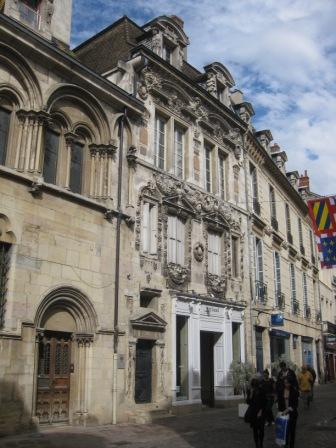
Nancy (pr. Nonsea) is, or perhaps I should say, was the seat of the Dukes of Burgundy, one of the most powerful families in pre-revolutionary France. Their impressive, though not that old, pile is shown here:


The town itself reminded me somewhat of Berne in Switzerland, which I profiled earlier this year, due to the extensive number of fluttering flags aloft in the various thoroughfares. However, the streets were much narrower and graced by often less substantial buildings. That said, the city's narrow streets conveyed a sense of elegant intimacy despite the inclement weather.


Note here the tight little courtyard - I thought I might see the Montagues and Capulets feuding on the circular staircase


And I loved this historic round-about for children.


AS


A Walk through Lyon

Our 3-day trip from Montpellier to Koln spent its first night in the great city of Lyon at the confluence of two major river systems - the Rhone (which has a source next to Phil's chalet at Saas Grund); and the Saone (which rises in northern France). Indeed, our accommodation was close to the junction of those two rivers in a sliver land housing the CBD.

Here are some images of the city taken the morning after our latish arrival on 24 August - see I'm behind a week on these posts, with comments on Nancy, Metz, the Moselle, Trier (Germany) and Koln still to come! Amble around the city with me, starting with a farmers' market on the banks of the Saone! The peaches I bought there were delicious.


And here is the Saone itself up-stream of the confluence with the Rhone, but still a large body of water. We went up to the church on the hill and, although a considerable edifice, it was undergoing full-scale restoration which made interior photography difficult. The structure on the west bank looked like a replica of the Eiffel Tower, but was much more mundane.


The central city is a maze of little alley-ways and squares like these examples - and difficult to navigate with cars.


To get to the hill-top there is a choice of funiculars like this one, mercifully saving tired feet after a long walk. Alas, the journey was mostly in tunnels offering few views of the city and surrounds. The final image shows what a great vista could be had from the top!


AS

Wednesday, 29 August 2012

Roman Remains

This time I'll introduce you two nearby masterpieces of Roman architecture and engineering. I am still stunned by how far advanced the Romans were perhaps 1600 years ago. Both structures are world class. They are the Pont du Gard (the aqueduct across the Gard river near Nimes) and the theatre at Orange near Avignon in the Rhone Valley. Again, go to Google to find out more about these MASSIVE structures! Here is the Pont du Gard. Do you recall seeing images of it in history books? By the way, I'm not the massive structure I was referring to!


Can you think of any modern aqueduct that rivals this for size?

And now to Orange. The theatre below, which is still in use today, can seat 10,000 people!!!! It is the most perfectly intact such theatre in the world! Enjoy it as we did.


Fabulous! You'll have to wait a while for postings on Lyon (where Emily once stayed for a few weeks), Nancy (home of the Dukes of Burgundy), Metz (after which a local Gorge in my home region of New England was named), the Roman city of Trier (now in Germany of course), the Moselle valley, and Cologne. I've made a record number of postings for one day already.

AS