Saturday, 22 August 2015

Castles of Man

During our stay on the Isle of Man, we visited the two incredibly ancient  castles documented here, starting with Castle Rushen in Castletown. It was beautifully preserved and made all the more interesting by excellent tableaux of life in the castle. Castle Rushen is, I understand, mainly dating from the 12th century onwards as Castletown became the main centre for the island. Douglas only became the commercial and political hub much later - in the 19th century. Have a look, starting with a real portcullis.


An imprisoned priest.


Cannon balls and other missiles.


Scenes from a banquet.


Warfare on tapestry.


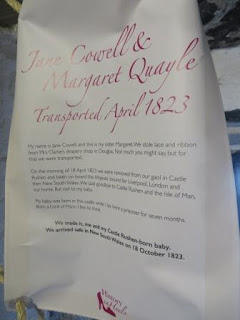
A prisoner and her child transported to Australia!

The kitchen.


A local chief seated on his 'throne'.


Meal preparation again.


On another day we visited Peel Castle on the west coast of the IoM. This, now ruined and mostly a shell, dates from earlier - the 11th century. Moreover, it was started by the Vikings who then controlled the island. Archaeologists have discovered Celtic remains during their excavations. The site is wild and craggy as the pictures show. It also covers several times the area of Castle Rushen.


The Castle's most famous "resident" is the so-called Moddey Dhoo or "Black Dog" ghost! The castle contains an impression of this animal close to the entrance.


The Manx people have protected and explained their heritage well and Peel Castle was no exception.

AS

Monday, 17 August 2015

Navigating Man

After leaving Portugal and arriving in Britain, I spent a few days with my brother Phillip in Poole. Then we flew to the Isle of Man for a 5 day visit. The island is quite compact and has an amazing array of transport for getting around in addition to the usual buses and taxis. In fact, the bus fleet is very modern and the services cover the whole island frequently, but that is not the purpose of this post. Here we're interested in the unusual and historic modes that also entertain visitors.

We bought a 5 day ticket that covered all transport except for taxis and provided automatic entry to all heritage destinations. So we immediately began exploring the fascinating ways of getting around the island. Have a look at what we saw, starting with horse-drawn tram cars on rails! These ran along the long Promenade in Douglas, the capital and largest city on the island. It was a useful and relaxing service that we used quite often and the trams were hired by waving one's hand at designated tram stops along the road.


Here a horse is being hitched to the tram car, and the succeeding photo shows the depot and another horse being readied for service. The vehicles themselves seem to date from the early 20th century and are largely open-air - all right in summer but probably chilly in winter.


Adjacent to the horse-drawn tram depot and stables was the start of the electric tramway where, in effect, the horse is replaced by overhead electric wiring, as shown here. The rolling stock is also a little younger and a mix of interior and open-air seating. Both are a little cramped and crude as the pictures show. The electric version goes faster than the horses and the line runs along much of the island's east coast, linking Douglas with the second largest town, Ramsey. I have a Canadian friend, Doug Ramsey who didn't until I pointed it out know that he had been named after the two largest Manx towns!


And then there's the line that runs from Laxey on the east coast to the top of Snaefell (Snow-fall) at a height of c. 2100 feet. Its rolling stock also looks like that on the east coast electric line, but is at least enclosed, something necessary on a cold island at high altitude.


Then, finally, there's the little steam train that links the electric tram at Laxey with the great Laxey water wheel - a major tourist destination. It is tiny! I'm 50% taller than either the locomotive or the cramped cage of a coach in which passengers are carried the short distance. Still, it was fun, and the line was used in earlier times to ferry ore out from the nearby mine.


Like these period pieces? Let me know.

AS

Saturday, 15 August 2015

Guimaraes: Cradle of Portugal

Another field trip took us to the historic city of Guimaraes, billed as the Cradle of Portugal. It was certainly a beautiful city, as the ensuing photos demonstrate. We must have spent two or more hours just walking the streets, the castle and the palace of the Dukes of Braganza. Again, just enjoy the visual imagery of the place, much of which is world heritage listed. And, at the end witness a procession of more than 50 entrants in a horse and carriage contest - rather fitting for town relying on its history.


We thought that this building sympathised with the Greeks in their financial struggles by flying part of the Greek flag.


In case you do not recognise the dude in this photo, it's actually me!


Th Ducal Palace dates from the 15th century. And its interior was richly furnished.


The castle itself is even earlier, dating from the 10th century.


AS