Saturday, 13 June 2020

A Trip up Herbert Park Road

At loss to use up my day effectively, I decided to take a drive around our district. As always, I tried to take an unusual route. And today I decided to drive up Rockvale Road north-east of Armidale. Rather than travel its full length, I decided to try the Herbert Park Road instead and, around 10 kmm north of our town, I did a left turn. I drove a further 40 km north towards Guyra on a sunny and warm Winter afternoon.

I was entranced by the whole picturesque route travelling about a third of the way on a sealed road before doing much of the rest on a good quality dirt road. Close to Armidale the route took me past many small hobby farms, but further out the farms became large and the homesteads were widely scattered. In fact, much of the countryside looked empty! Over something like 40 km I never saw another car! I was all alone. So I stopped the car from time to time and tothe last ook a heap of lovely pictures like those shown here. Just have look at the lovely countryside! The first ones were taken at 1000 m above sea level and the last ones were about 1300 m - much higher on the New England Tablelands. Even at that altitude, the temperature recorded by may car was still close to 15 C - even in mid-winter.

As you can see, there's a lot of wide pasture-land, mostly brown in colour except for the occasional green paddocks where irrigation water is available and / or the pastures are top-dressed with nutrients.


A good quality dirt road!


One of the most evident characteristics of the pastures was the absence of livestock - sheep and cattle.


There great vistas. Looking south I could make out high country peaks some 60 km away.


The route had several river crossings in valleys like these below. One, the Gara Fiver, flows down to the spectacular waterfall I reported on earlier this. year.


The cone shown in the distance below is likely to be the core of an extinct volcano - much of the Tablelands area is covered in igneous rocks with thin top-soil that makes grain farming unlikely - but leads to widespread pasture.


Well, I did see occasional livestock later on in my trip. This field contained, unusually, both cattle and sheep.


At last, the dirt road became sealed - good quality work!


AS

Sunday, 7 June 2020

More Cloudscapes

I went for another long walk this winter afternoon, but it was a glorious day. Brilliant sunshine warmed the temperature to about 14 C, which is good for winter. And then scattered and mostly thin clouds encroached to produce the images shown below. I was riveted by the colours and especially all the light white patches. That's all I have to say! Enjoy what you see.


AS

Tuesday, 2 June 2020

Brrrrr

The first of June marked the first day of Winter here and, for once, the weather changed accordingly. Throughout Autumn, we had amazingly warm days with temperatures occasionally rising to more than 20 C (68 F), hardly any frosts, and many lovely sunny days.

Yesterday, a fierce front came through from the south-west giving us a few rain showers and sending temperatures down about 15 C (60 F). Despite that, I rose at 6.30 am this morning to go for a walk as the day dawned bright and the overnight temperature was still around 5 C. I had only been back 30 minutes when something amazing happened. Dark clouds swept in driven by 30 kph westerly winds, the temperature shrank rapidly and it started snowing! This was by my calculation the first snow we'd experienced in 5 years. I couldn't resist taking some pictures of this event, some of which are shown below ... and one included is a short video. I expect that my readers in the UK and USA will laugh with contempt at our puny efforts at generating white flaky stuff and, to be honest, it didn't lay frozen on the ground. The sun came out after a short while and that was the end of our snow storm. Mind you, the maximum temperature today was just 5.2 C (41 F) and we decided to stay indoors in such frigid conditions. We also had wind gusts up to about 57 kph (35 mph) which created an 'apparent' temperature of just minus 6 C at 10.30 am - even with the sun out!

Here's what we saw: OK the snow is almost invisible, though it looked heavy to us.


However, the video might show the event better:


Comments welcome.

AS

Sunday, 24 May 2020

Mount Yarrowyck

One of my favourite walks in our beautiful New England high country is the journey from the car-park at the base of Mount Yarrowyck to the Aboriginal rock art in a little cave about 1.5 km from the starting point. A week ago, in mid-May, the day dawned bright and amazingly warm for this time of year. Looking for something interesting to do in our district, but within permitted travel distance given the COVID-19 virus, I selected the trip to Yarrowyck and back.

Travelling westwards along the Bundarra Road about 12 km from where I live takes me to this spot. We're on the continental divide - the point on Great Dividing Range where water flows westwards through the Murray-Darling system to the southern ocean near Adelaide, a distance of maybe 1400 km in a straight line. Given that the point where I'm standing is about 1150 m above sea level, that means the river, for much of its course, is very gently sloped. To the east, where I am looking, the rivers flow to the Pacific Ocean, a distance of only about 150 km.


Travelling about another 12 km to the west, I arrived at the Mount Yarrowyck nature reserve to start my walk.


The minimal facilities include a toilet and a table to rest and maybe eat, but the notable thing is the jumble of massive rocks all over the area and along the path leading to the rock art. These would have fallen off mount Yarrowyck over tens of thousands of years and I had fears for my safety!

Upon starting my walk, I admired the view to the south across the pastures where cattle graze. The path up to the rock art winds through attractive landscapes and eucalyptus forest.


And Mount Yarrowyck itself, shown here, lay northwards from the path. As I travelled along the 1.5 km long path, it got progressively steeper. And eventually I approached the rock shelter shown below.


The art itself appears to me getting fainter over the years. According to information provided at the site, the ochre sketches may be several hundred years old.

After looking over the art-work maybe 15 minutes, I turned for the walk back to the car. But the landscapes I saw as I walked east-wards seemed extremely picturesque.


And after getting back in the car to drive home I admired the wide open countryside to the east, with the top of the Great Dividing Range rising and falling in the distance.

Our region is a great place to live with its great landscapes, marvelously clear air, abundant sunshine, and high amenity.

Come all ye relatives and join us in paradise.


AS


Thursday, 7 May 2020

An explosion of Little Corellas

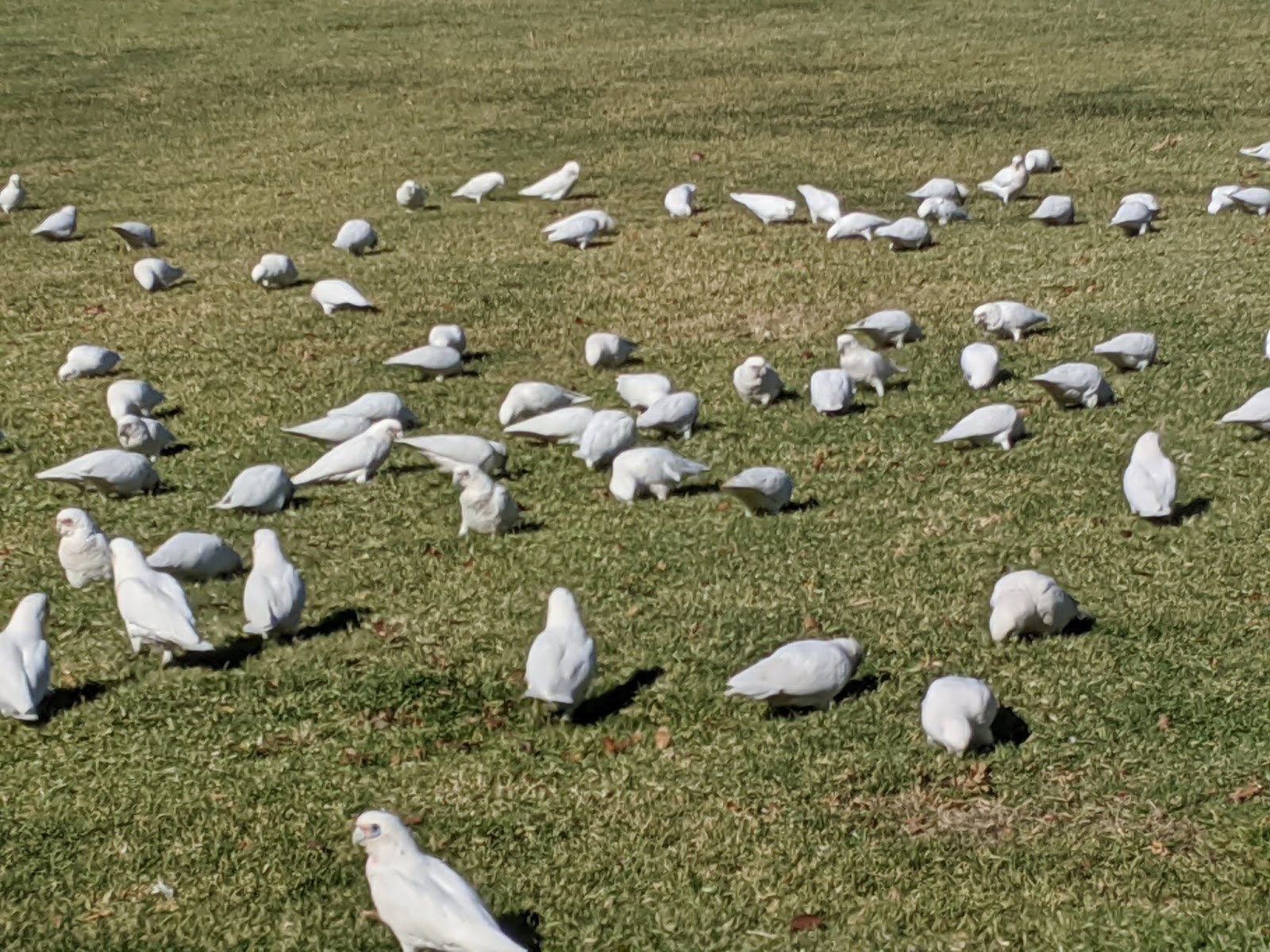
I was out on another of my daily walks when I came across a mass of Little Corellas on the ground looking for a feed. Fortunately they either didn't notice me or see me as a threats. and so I was able to take these photos. These pretty birds fly around in huge flocks and I'd guess that there could be upwards of hundreds of them wheeling in the sky.


I've looked up the species in one our bird guides and they're not even listed as located in our New England region. That was probably true a decade ago when I cannot recall seeing them in our vicinity. But suddenly they have taken our locality in large swarms. And now many people regard them as pests. Alas, one of their habits is eating the berries on our town's many Pistatio Chinensis trees - we've got three of them in our garden alone. And while they're doing that they defoliate trees leaving piles of leaves and twigs on the ground. This is such a shame as I rather like looking at them as aerial gymnasts.

Having photographed them, I continued my walk on yet another radiant day. We've recently had lots of sunshine and temperatures in the region of 16 to 20 C - somewhat above the May average for our location of just 16 C for the month.

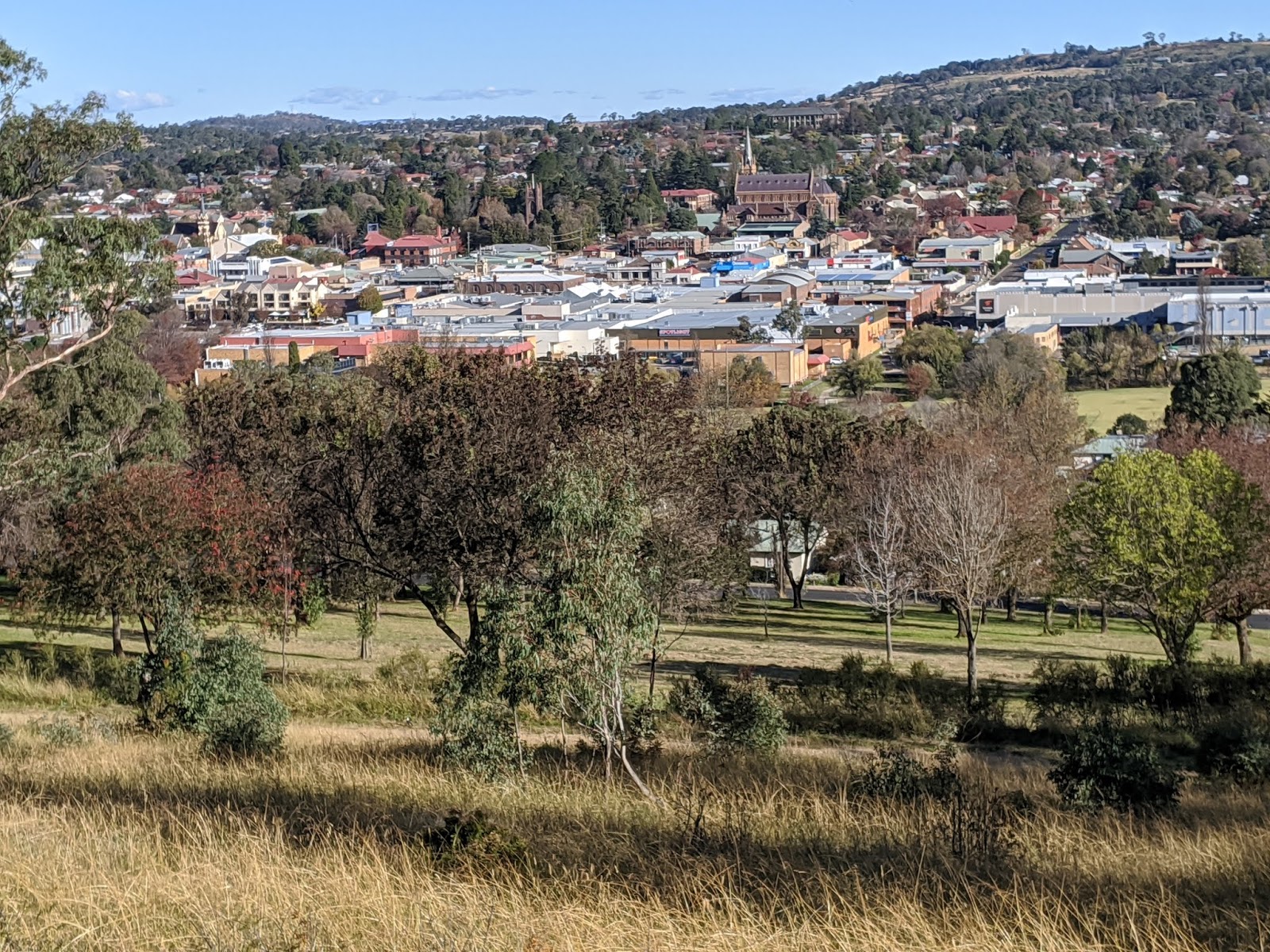
I couldn't resist taking yet more views of our delightful little town - shown below. The first looks towards the south-east, the second to the south-west from the Apex lookout up on north hill.


And this looks eastwards from one of our nearby streets showing the Autumn foliage of  the multitude of deciduous trees lining our streets. Notice however, the brilliant blue of the cloudless skies.


AS

Tuesday, 28 April 2020

Lovely Cloudscapes

I went for a long walk this afternoon and was entranced by the cloudscapes surrounding me. Just look and enjoy. Yet again, the temperature today was way above the late April average - about 21 C. and the breeze was blowing gently.  For those who know Armidale, all the pictures - shown here in chronological order - were taken while walking along Apple Tree Hill Drive just out of the city's built-up area. The area is covered in hobby farms.


The vegetation along much of this rural route is native - mainly eucalyptus. And, unlike the deciduous trees I have reported wearing their Autumn colours, they remain green all year round


Now you know why I like walking in and around our pleasant city.

AS