The last 6 months, including this Christmas - New Year break, have seen me do a few things that have been off the menu for a good few years. For example, the trip to Broulee mentioned a few posts ago saw me frolicking in the surf and even body boarding. Back in July I rode a scooter something like 700m down a mountain-side in Switzerland and then swung like Tarzan between trees in a forest. Come to think of it, I also had a few trips on a flying fox last year.
Well, the trip to Canberra last weekend provided another reminiscence of earlier days: I went 10-pin bowling! My earliest recollection of this deafening 'sport' was a game at an alley at Leicester Square in London at something like 5am. Don't ask me what I was doing there at that time! Anyway, this time around the alley was alongside Lake Gininderra and the time was a more respectable early evening. The deafening part was the blast of loud, but unidentified, muzak coming from a constellation of LOUD-speakers.
Apart from me, the participants were Emily, Rebecca, Greg and Max. He did especially well given he's only 6 and was rather dwarfed by the size of the ball. I won, if the aim of the game is to get the lowest score. Oh! It's not quite like golf. In fact, I probably got the lowest score anywhere in the world that day! In the second game, two-thirds of my tosses were off-line and failed to hit a single pin. Instead of a maximum 300, my score was a miserable 40+. That may well be my last game for a while, perhaps ever. My last round of golf was 35 years ago when I managed to do the last 9 holes of the Armidale golf course in an impressive 96. Factoring that up gave me 192 for 18 holes. Unsurprisingly I retreated to the bridge table.
I suppose the lesson from all this is that retired professors don't have to boring old farts. Such escapades might even be life preserving.
AS
Wednesday, 19 January 2011


Tuesday, 18 January 2011
A Baptism and a Funeral
If my memory serves me correctly Hugh Grant starred in two weddings and funeral. I even went to the see that film - unusual for me, though I'm off to see the King's Speech when it arrives here shortly.
I was reminded of the film over the last week as I attended one funeral and baptism, both held under the auspices of the Catholic church. The former was for a long-term colleague, John Pigram, who had been in ill-health for some time. We'd known each other since my arrival in Australia almost exactly 40 years ago to the day, but John had retired well over a decade previously and out paths had rarely intersected recently. However, there was a large turnout of past and present colleagues for the farewell.
The second was for the arrival last year of James Castle, whose father, David, is brother to Greg, Emily's husband. It was a very large family affair, for Evina, James' mother has - if my information is correct - nine other brothers and sisters. I attended the sumptuous party afterwards, but not the ceremony itself for I was looking after Max at the time and there's no way he'd sit still through a long ceremony!
The first event was in Armidale and the second about 4 days later in Canberra, 800 km apart.
AS
Thursday, 13 January 2011
The Singularity Is Near
I've just been whiling away time reading an article about Ray Kurzweil, the famous businessman and futurologist. That lack of discipline on my part could be costly, if Ray is correct! That's because has predicted that 2045 is the year of THE singularity when humans will have to be given supplementary brain capacity to deal with all the knowledge and information surrounding us and process it to make accurate decisions. I gather that we'll have to attach our brains to a battery of ultra-fast computer chips (or CPU) and storage back-up.
Of course, he couldn't know that I'll be turning 100 in that year, which raises some interesting questions. Because of my age, will I face discrimination in the surgery needed to augment my brain capacity? I hope not because I'm hoping adopt his health regime that he predicts will make him immortal, which will be fun. Imagine this, too. Even if I pass away shortly after my 100th birthday, I will have immortality of a kind. This is because the extra CPU and storage capacity wired to my brain will be able to download the contents of my memory for posterity. Still, I'd like to be around to experience all that life will increasingly offer.
No doubt, good readers, you'll conclude that I'm already becoming deranged and should offer myself for euthanasia. But, consider this! According to Ray's predictions, we will witness in the 21st century something like 20,000 years of progress at today's rate, or roughly 10% compound over the 100 years. That's why I castigated myself at the start of this piece. If knowledge, information and processing power are expanding exponentially at that rate, then reading that article could be a major indiscretion on my part - except perhaps it inspired this post. We've got no time to lose before being swamped by technology!
All this prompts some more predictions on my part. If Kurzweil is only half right, businesses and government are in for some exquisite turmoil. In fact, it will hurt government far more than business because the latter is far faster on its feet and business almost always leads in the technology game. Government, in practice, is desperately slow in making most decisions because of the need to debate different points of view and seek compromise solutions. Do you want to bet that by 2045 most of government will become completely dysfunctional? This process might bring more uncertainty to human affairs than all of chaos theory, complexity theory, and quantum mechanics put together.
I must stop here and start revising my Monterrey paper accordingly.
AS
A Nice Set of Numbers
The Australian Bureau of Statistics has just released employment data for Dember 2010 and they're a nice set of numbers. The unemployment rate fell to 5% and the participation rate remained at a high 65.8%. Over 2010, the workforce was up 3.3%, while unemployment fell a large 8.1%. So things look rosy nation-wide, and I doubt that the Queensland floods will have an impact on these numbers, which are all headed in the right direction. No wonder the stock market took off after the figures were announced.
AS
AS
Monday, 10 January 2011
Water Water Everywhere
Some parts of the world are experiencing severe drought. Others are buried under meters of snow. And yet others are ravaged by flood. Just to remind you, the area of Queensland under water is now estimated to be greater than the area of France and Germany put together. The rain keeps coming and is now moving south of the border in our direction. After days of dull weather and misty rain, it is now beginning to rain harder and more steadily. Moreover, our local forecast sees the rain continuing for much of the week as a surface trough over the North Coast moves southwest - in our direction - and merges with another trough coming from the west. The winds are from the northeast bring moist and humid air in off the coral sea.
Our weather problems are mild compared with SE Queensland. The Mary River (affecting Maryborough and Gympie) has a 20m flood - that's > 60 feet in UK language if British Readers readers can believe it. That's the outcome of 350mm of rain overnight (or c. 14 inches). Many other coastal locations are drowning, including Brisbane and, of course, Rockhampton whose plight flashed around the world. Unusually, this rain has swept far inland and we've just watched pictures of vehicles being swept downstreet in Toowoomba to the north of us, a city 4 times the size of Armidale. To their west, Dalby has just been severely flooded by the Condamine system for the second time and even further downstream is St George, which has had close its largest flood ever - the second in two years. St George is one of the cotton producing communities whose small businesses we've been studying and is now a bit of a mess! We were last there three months ago.
In most countries floods are fast moving events. Australia's floods, especially to the west of us in the Murray-Darling basin, tend to be massive and slow moving affairs. There's an old story told of a paddle steamer moored on the Murrumbidgee River at Hay in the south of NSW. A big flood tore the vessel from its moorings and, after the flood subsided, locals scoured the countryside for it. Eventually they found the boat 17km (10.5 miles) from the river bank!! Water now flowing down the Condamine will take at least 4 months to reach the sea and, in the process, spread out over vast areas of inland NSW. Even the coastal rivers like the Fitzroy flowing through Rockhampton have flood peaks that may take a week or so to start subsiding in any meaningful way.
We're still in early summer and the prognosis is for a sodden continuation of the start. Armidale has hardly had any warm weather and today the temperature hovered around 20C, little warmer than a good day in mid-winter. We'll soon find that our tans are actually rust!
AS
Friday, 31 December 2010
Back Home
After an 800km drive, including an overnight stop at Raymond Terrace just out of Newcastle, we reached home by lunch-time today. At Newcastle we have a choice between taking the New England Highway, which is generally a good road or the slightly shorter route via the Bucketts Way to Gloucester (nothing like its UK counterpart) and then the Thuderbolt's Way to Uralla and Armidale. Thunderbolt was a 19th century bush ranger (outlaw) who held up stages coaches quite successfully until eventually tracked down and killed. We now tend to take the latter route because it is so scenic and little trafficked, though the surface of the road is horrid in places. Gloucester is transforming itself into a tree-hugger's paradise and lots of good cafes for coffee and/or lunch. The route also has about 160km between Barrington and Walcha with no settlements on the road. The trip is entirely rural through picturesque mountain and river scenery, along with some of Australia's best grazing country.
The photos below show some of the scenery en route from Carsons Lookout. The three pictures adjoin each other and present a vast sweep of countryside looking westwards towards the Barrington Tops, a National Park with vast wilderness areas up to 1100m in height. The Barnard River in the valley below is at about 200m, while the lookout itself - alongside Thunderbolt's Way - is about 920m. So the valley floor is more than 700m below (or c. 2200 feet). It's an impressive view and we often stop for a little R & R on the long stretch to (or from) Walcha. Even at 920m the weather was very hot(!) at 10am, and the humidity low, which is why the images are so clear.


AS
Central Tilba Tilba Tilba
The title of this post is not the result of my going mad or suffering from heatstroke. Our next two destinations were Central Tilba and Tilba Tilba. See http://www.tilba.com.au/history.htm for a general blurb or sites like http://www.maplandia.com/australia/new-south-wales/eurobodalla/tilba-tilba/ providing maps. Tilba may mean water in the Thawa Aboriginal language and its repetition converts it to plural form: many waters. Both places, which are only 3 km apart, are now, like Mogo, thoroughly gentrified and full of eateries and touristy shops catering for alternative, hippie, and green clienteles - both young and old.
They are set in stunning rolling hills and valleys, a lush green colour after recent heavy rains. The first picture shows the general lie of the country south of Central Tilba.

Before getting to Central Tilba, Dot and I and Emily and Greg had a nice lunch in Tilba Tilba at the "Love at First Bite" cafe shown on the next slide. It was surrounded by businesses selling garden supplies or twee household goods, and there was also a botanical gardens to explore.

Then it was off to Central Tilba, another old dairying township, though this one - unlike Mogo - actually had two stores selling cheeses. Indeed Tilba cheeses are available in supermarkets nationally and they're very good. One now sits in our fridge having survived the trip home in an Esky. We visited most of the stores shown in the attached pictures, but bought little. In Emily and Greg's case, that was hardly surprising in view of their impending move overseas. In our case, the household is stuffed to the ceilings with rarely used household and personal items! Still, it was fun looking at works of art, hand-made wooden products, exotic clothing, furnishings, food-stuffs, hammocks, and so on.
Have a look at these photos!


AS
Meringo
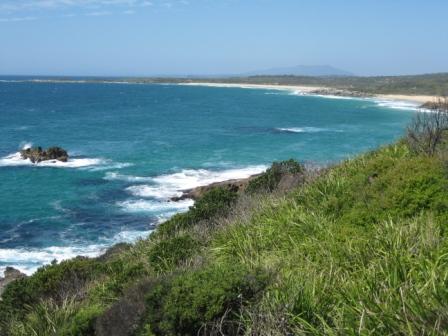
One of the joys of the South Coast is its succession of marvellous beaches, headlands and sea-scapes. Our trip down the coast two days ago opened up this landscape in ways that astonished us. Our main coastal destination was the tiny village of Meringo on the edge of the Eurobodalla National Park - which also has a marine extension. The following pictures illustrate my point and I'd dearly like to escort some of my European readers through this region - which we hardly touched and goes for hundreds of kilometers.


This is the view northwards from the southern end of the first beach.

The pictures above and below look north and south respectively from the headland in the final picture and show Honeymoon and Mullimburrra beaches respectively.


Come on down and enjoy this scenery with us and at least tell me what you think of it.
Happy New Year to all my readers.
AS

We walked much of the length of the beach above and were, apart from two cyclists, the only people on it. The sand was clean and unmarked - totally pristine - and only sea-gulls attended us. The view is southwards.

This is the view northwards from the southern end of the first beach.

The pictures above and below look north and south respectively from the headland in the final picture and show Honeymoon and Mullimburrra beaches respectively.

Come on down and enjoy this scenery with us and at least tell me what you think of it.
Happy New Year to all my readers.
AS
Thursday, 30 December 2010
Mogo
After the morning on the beach reported by the earlier post, several of us headed inland to Mogo on the Princess Highway, which connects Melbourne and Sydney via the coast. It is mainly a tourist route because commerce takes the far shorter route inland. In its previous incarnation a century ago, Mogo was a gold-mining town. It then decayed gently for many decades before commencing a stunning revival as an olde-worlde shopping centre full of counter-culture boutiques. As far as I could tell, hardly anyone actually lives in Mogo, and all the former miners' cottages have been converted into shops, cafes, and art galleries. Even the Catholic church has had a makeover into an art gallery!
We spent much of the afternoon wandering from one store to another, though not buying anything other than fudge and ice-creams. Fortunately, Max stayed behind with Greg playing games. He would have found Mogo deadly dull for someone of his age! For example, one store sold merchandise with cow motifs (pictured) which might appeal to an older generation! In fact, after the expiry of gold mining, Mogo was a dairying area like much of the South Coast.
The following pictures give you a general impression of the town. It's pretty, you'll have to agree.


 AS
We spent much of the afternoon wandering from one store to another, though not buying anything other than fudge and ice-creams. Fortunately, Max stayed behind with Greg playing games. He would have found Mogo deadly dull for someone of his age! For example, one store sold merchandise with cow motifs (pictured) which might appeal to an older generation! In fact, after the expiry of gold mining, Mogo was a dairying area like much of the South Coast.
The following pictures give you a general impression of the town. It's pretty, you'll have to agree.


Kiama and Ulladulla
The trip down the south coast from Sydney to Batemans Bay and Broulee is highly scenic and one of the most popular tourist sights is the blow-hole at Kiama. The trip was marred by persistent and fairly heavy rain, but in between the showers we were able to see the blow-hole in action. The first picture shows part of the local coastline, the second is a general view of the blow-hole area - a rock platform under which the sea has gouged a cave system ending in a vertical shaft through which spray is ejected. Waves, especially at high tide, surge through the cave and force of the water sends a column of spray up through the vertical shaft. It was very impressive. The final picture shows the harbour at Ulladulla alongside where Dot and I had lunch.


AS


AS
Subscribe to:
Posts (Atom)