If there's one thing Rotorua is renowned for it is the region's thermal activity - a true hot spot on Earth's surface. And, of course, we headed early to look at some of the spectacular activity. Our first stop was an innocent looking park surrounded by city buildings. Looks nice doesn't it.

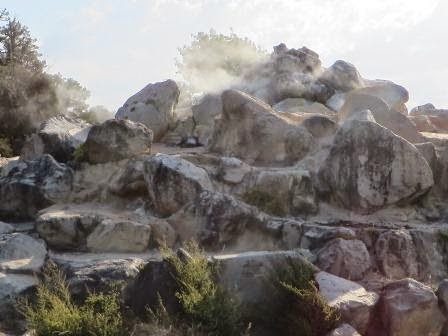
But then the visitor notices some fenced off areas belching steam - not just some. Rather I should have said a lot.

And on closer inspection, they were home to bubbling pools of mud, steamy holes full of hot water, and larger lakes covered in mist.


There were also terraces covered in white and yellow deposits, the latter presumably being sulphur.


I was stunned by how close people were living and working to these thermal wonders, especially - as a coming blog reports - they go bang on a massive scale. Oh well! I suppose it's no different to living in a shaky place like Fukushima.

Another day, another destination. This time it was the Pohutu Geyser, one of the biggest in the southern hemisphere. We spent a long time circling the geyser waiting for a large eruption, but nothing much happened for the first hour or so - just steam hissing from the geyser and nearby vents. These were interesting, but nothing like the big show of a 30 m (c 100 ft) column of scolding water.


Just look how close this hotel is to the scene of the action.


Or these dwellings.


Here goes! The show as promised. However - and perhaps this was wise - we were quite a way from the front stalls!

AS
But then the visitor notices some fenced off areas belching steam - not just some. Rather I should have said a lot.
And on closer inspection, they were home to bubbling pools of mud, steamy holes full of hot water, and larger lakes covered in mist.
There were also terraces covered in white and yellow deposits, the latter presumably being sulphur.
I was stunned by how close people were living and working to these thermal wonders, especially - as a coming blog reports - they go bang on a massive scale. Oh well! I suppose it's no different to living in a shaky place like Fukushima.
Another day, another destination. This time it was the Pohutu Geyser, one of the biggest in the southern hemisphere. We spent a long time circling the geyser waiting for a large eruption, but nothing much happened for the first hour or so - just steam hissing from the geyser and nearby vents. These were interesting, but nothing like the big show of a 30 m (c 100 ft) column of scolding water.
Just look how close this hotel is to the scene of the action.
Or these dwellings.
Here goes! The show as promised. However - and perhaps this was wise - we were quite a way from the front stalls!