Sunday, 25 January 2015

Turangi - Tongariro

For the next week of our stay in New Zealand we based ourselves in the small town of Turangi at the southern edge of the massive Lake Taupo, which is 46 km N-S and 33 km E-W and has a surface area of 616 km2. Our selection criteria for a place to stay were simple that we had to be near Mt Tongariro because Bec and Max were off on a 4-day hike (or tramp as the locals call it) around that mountain and the adjacent Mt Ngauruhoe. Secondly, there had to be a lot for Dot and I to do in their absence. Turangi fitted the bill nicely. Those mountains are impressive as the pictures show, especially Ruapehu, which is snow covered most of the year - even in mid-summer - and is 2800 m (9100 feet) high  In the second picture, Ngauruhoe is the almost perfect cone to the left. These volcanic peaks are active, with steam coming out of Ngauruhoe's vents all the time and Ruapehu erupting in a minor way 60 times since 1945 and spectacularly in 1995-96.


We stayed at Creel Lodge in Turangi, which was delightful. We had large well-appointed rooms in lovely surroundings close to the lovely Tongariro river which attracts lots of fly-fishers trying to catch trout.


There is also a nearby trout hatchery open to visitors telling of the history of the fish in NZ and how the stock is managed, with self-guided walks through the various facilities. The first picture below shows a swarm of fingerlings presumably close to release into the Lake Taupo and its feeder streams. The river banks are home to many long walks, some of which Dot and I took and, at one point, I hired a bike to travel something like 10-12 km  through the enchanting landscape. One of the pictures here shows Turangi from high up on a bluff overlooking the river. Finally, the hatchery was also in the business of hatching birds, namely the Whio. This endangered species features on NZ's $10 note.


Although, Dot and I were alone for 4 days, we immediately targeted a ride in a two-stage chair-lift on Ruapehu to look at its dramatic scenery. Here we're on our way up past the NZ equivalent to chalets and into a fairy-tale world with lots of oddly shaped pinnacles and barren slopes graced with the occasionally tumbling waterfall.


Just above the snow line Dot and I posed for photos taken by the other.


Three days later we did the same again, but this time with Bec and Max after they finished successfully their marathon trek. Max loved throwing snowballs and sliding down the slops on his bum.


AS

A cultural night out

Our last event in Rotorua was also one of the most entertaining. We went to a hangi, or what the Melanesians in Papua New Guinea call a mu-mu. Believe it or not, I once went to a mu-mu here in Armidale. In effect meat and maybe vegetables are cooked by (i) digging a deepish hole in the ground, (ii) putting combustible material- for example wood - in the bottom and setting light to it, (iii) putting your pig's carcass and other ingredients on top, (iv) covering the whole lot with earth or sand, and (v) slow cooking everything for maybe an hour or more. The hole we dug was outside the building where my office was, and in the countryside outside of Rotorua, the mechanism was similar as we saw for ourselves.

The large number of guests for the hangi were transported to the venue in a fleet of buses, and, en route, I had the honour of being appointed a tribal chief - the tribe being passengers in our bus. On arrival at the Maori village the various chiefs stood out in front of their tribal members for a ceremony in which we were confronted by warriors from the local community in a ritualised greeting / show of force. They wanted to know if we came in friendship or as enemies. Having confirmed the former, we were shown the hani in preparation, and guided on a tour through the village to demonstrate traditional Maori lifestyle and culture. Here's Bec playing a game akin to pass the pole.


This lady exhibited traditional woven goods - baskets and that kind of thing.


Here, Max is watching a game played by the men of the village - and I played another myself shortly after, along with the chiefs.


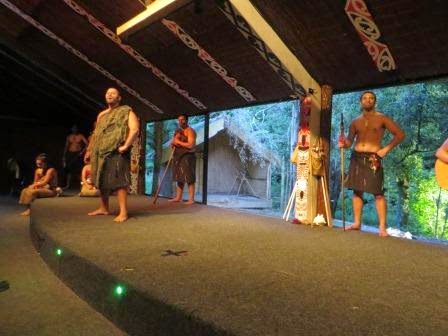
Then we were seated in a long-house to witness a haka, dancing and singing


Finally, we came to the meal, which was delicious.


All in all a lovely night out.

AS

Thursday, 22 January 2015

Rotorua's Other Side

While Rotorua is principally renowned for its bubbles, smells, hot water plumes and things that go bang, it has plenty of other attractions, which we sampled. Bec and Max went zorbing with me tagging along as official photographer. Never heard of it. Well basically one climbs into a large perspex balls which then rolls down with you inside clad in as little as possible because water acts as a lubricant to save you from (a) spending too much time upside down and (b) grazing oneself in the device.

One could come down a zig-zag course, which slower and more gentle or faster in a straight line.


Here's Max jumping for joy after his first zig-zag run, Bec coming down inside her ball, exiting excitedly, and then jumping ecstatically for the camera!


Soon after the zorbing we found ourselves in a gondola car rising high above Rototua with lovely views of the town and lake.


At the top we donned headgear and headed for the Luge. This was not a snowy job but rather a downhill run on a tight track in a kind of cart and one could reach quite high speeds. We did three runs: introductory, intermediate and advanced, each on a slightly different track. Suffice to say that the more one did the journey the faster the speed, the trickier the corners and more uneven the surface.


I haven't photos of any of us going down this luge - for obvious reasons. But after getting to the bottom there was a Swiss style chair lift back to the top. Here's Bec and Max in front.


And half way up I had the presence of mind to photograph someone going down on the introductory track.


 After the Luge, we headed to the big swing. The seat accommodated 3 people, all heavily strapped in, as shown here. And there were several other safety devices for reasons that will become clear.


The seat was winched up adjacent to a tower, at which point we faced the ground and the steel cords holding our seat were horizontal. At this point, Max pulled a cord which freed our seat from being attached to the tower. Guess what. Amidst screams we hurtled towards the ground at 150 kph (over 90 mph), but of course didn't hit it. I have a photo which shows me with a grotesque expression on my face that's unpublishable.


That was enough fun for one day.

AS

Big Bang

In the early 20th century, more that 100 years ago, the Waimangu Valley near Rotorua was subject to a massive volcanic eruption which completely reshaped it, destroying all vegetation, some beautiful volcanic terraces, existing lakes and so on. We took a trip from the top of the valley to the bottom to examine what happened and what replaced the former landscape, and the current state of volcanic activity. It was a beautiful, mercifully supplemented by a bus bus ride back too the top to save us a long steep climb. Again, my pictures tell the story, interspersed with occasional comments of my own.

We start with an artist's impression of the valley after the eruption - shorn of all its vegetation and covered by layers of ash. Compare this to most of the remaining photos, typical of which is the second exhibit taken from the start of our descent. Dot, Bec and Max are seen peering over the now lust countryside. It's amazing how rapidly regeneration can occur.


A now fairly quiescent crater lake close to the top of the valley.


Another hotter and more active lake lower down, with steam gently arising from the surface.


Fed in part by hot water channels emptying into it, depositing en route sulphur, and sometimes creating pretty crystalline surfaces as shown in following picture.


As we went down, the landscape became wilder and more beautiful.


The river flowing through the enveloping gorge would have been warm had we tested it - a micture of normal stream flow and hot water injected into it.


Max admiring one of the several terraces now being re-established. Notice again the yellow hue.


And here I am wondering if the railing I'm perched on is robust enough to prevent me falling on to the scalding surface below.


After a short ascent we came to this wonderful crater lake with its iridescent blue water. It's known as Inferno Crater, so we can assume it always look like this!


Hot water spouting from a vent, eventually forming yet another fairly smooth volcanic terrace - as evidenced by the next two photos.


And all this water eventually flows into the lovely lake occupying the scene of the original devastation. It replaces several other lakes and some wonderfully coloured terraces that disappeared forever in that massive explosion a century or more ago. Now doubt nature is preparing for a re-run some time in the future. I wouldn't want to be around then.


AS